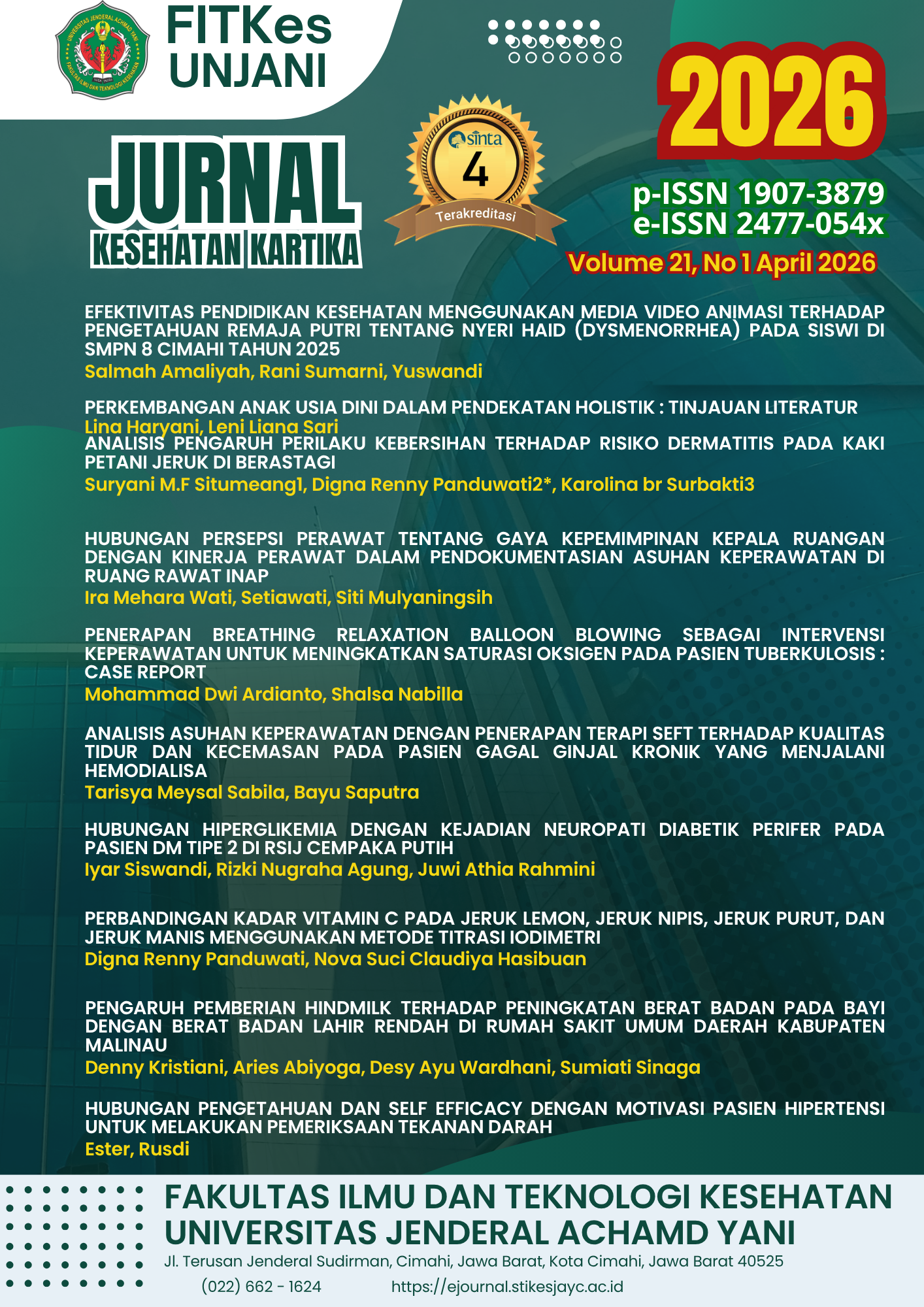
PENERAPAN BREATHING RELAXATION BALLOON BLOWING SEBAGAI INTERVENSI KEPERAWATAN UNTUK MENINGKATKAN SATURASI OKSIGEN PADA PASIEN TUBERKULOSIS : CASE REPORT
DOI:
https://doi.org/10.26874/jkkes.v21i1.536Keywords:
Breathing Pattern, Oxygen Saturation, Balloon-Blowing Technique, TuberculosisAbstract
Background: Tuberculosis (TB) remains a global health issue with high incidence rates in Indonesia, including West Java Province. Patients with pulmonary TB often experience abnormal breathing patterns that lead to decreased oxygen saturation. Non-pharmacological interventions are needed as complementary therapies to help improve respiratory function. The balloon-blowing breathing relaxation technique is a breathing exercise aimed at improving lung expansion and gas exchange efficiency through the mechanism of positive expiratory pressure. Objective: To describe the application of the balloon-blowing breathing relaxation technique as a nursing intervention to improve oxygen saturation in patients with pulmonary TB. Methods: A descriptive approach using the case report method, covering the nursing care process from assessment to evaluation. The study subject was Mr. J (70 years old) with a medical diagnosis of pulmonary tuberculosis in the Lavender Ward of X General Hospital. The intervention was administered once daily for 15 minutes over three consecutive days. Oxygen saturation measurements were taken using a pulse oximeter before and after the intervention. Results: There was a gradual increase in oxygen saturation from 93% on the first day to 98% on the third day following the intervention. The patient also reported a reduction in shortness of breath and appeared more relaxed. The nursing problem of ineffective breathing pattern was resolved after three days of intervention. Conclusion: The balloon-blowing breathing relaxation technique proved effective as a self-care nursing intervention in improving oxygen saturation in patients with pulmonary tuberculosis. This intervention can be recommended as a complementary therapy in clinical nursing practice to support improvements in patients’ oxygenation status.
Downloads
Published
How to Cite
Issue
Section
License
Copyright (c) 2026 JURNAL KESEHATAN KARTIKA

This work is licensed under a Creative Commons Attribution 4.0 International License.